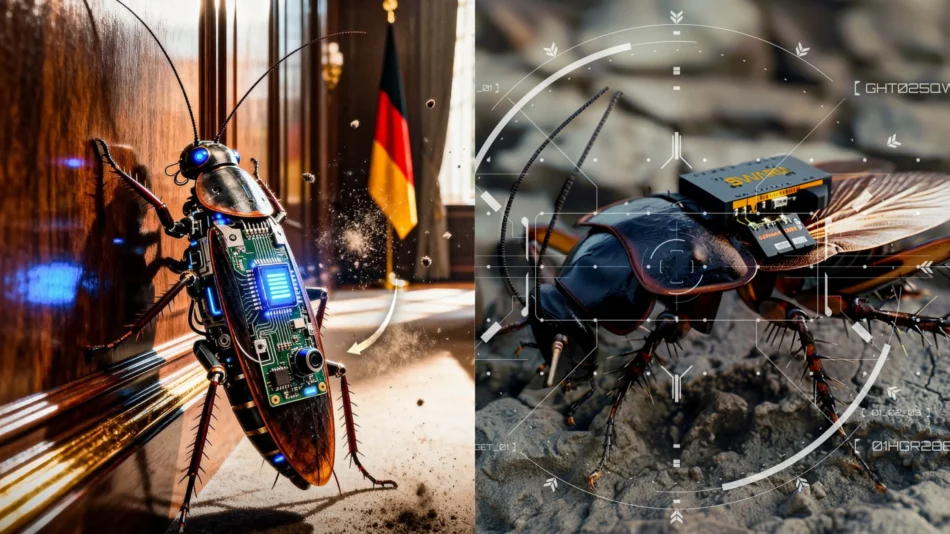

In a remarkable, if unsettling, technological breakthrough, scientists in Germany are developing AI-enhanced, bio-hybrid cockroaches intended for use in surveillance, espionage, and search-and-rescue missions. These insects have been engineered to combine the best of biology and robotics, carrying microchips, thermal sensors, and AI-driven navigation systems that allow them to crawl into spaces no human—or even conventional robot—could safely reach.
The project, led by researchers at a leading German Institute for Robotics & Bioengineering, seeks to harness the natural advantages of cockroaches: their small size, flexibility, and ability to squeeze through tight gaps. By attaching microelectronic hardware and communication modules to the insects’ bodies, operators can remotely control them, guiding their movement through vents, cracks, and debris. Thanks to AI navigation algorithms, the cyborg roaches can autonomously avoid obstacles, map unfamiliar environments, and provide a live feed of both audio and video from areas otherwise inaccessible.
These bio-hybrid cockroaches are equipped with highly sensitive thermal sensors, enabling them to detect heat signatures—making them ideal for locating survivors in collapsed or disaster-struck buildings. Their wireless modules stream real-time data, so operators on the ground can monitor conditions, track movements, and relay critical intelligence back to command centers.
Although the original goal of the research was to support search-and-rescue operations, the technology’s military and intelligence potential has not gone unnoticed. Defense experts are raising alarms about the ethical and security implications of such insect-based spies. With these cockroaches, governments could potentially send living, AI-powered agents into hostile or sensitive areas to gather intelligence—without risking human lives or relying on traditional machines that may be too bulky or conspicuous.
Privacy advocates and bioethicists are also voicing concern. The fusion of living organisms with electronics challenges existing legal and ethical frameworks: Who regulates the deployment of these creatures? What safeguards exist to prevent misuse? And, perhaps more disturbingly, how far can science push the boundary between life and machine before unintended consequences arise?
Proponents argue that, for now, the technology represents a genuinely promising tool for disaster relief—especially in scenarios where drones or ground robots cannot navigate safely. When a building collapses in an earthquake, for instance, these cyborg cockroaches could make quick, life-saving assessments without risking human rescuers.
Still, the blurred lines between biology and robotics have stirred intense debate. As Germany quietly tests this next-generation surveillance tool, the world must grapple with the profound implications—from national security to moral responsibility—that come with unleashing AI-controlled insects into the wild.