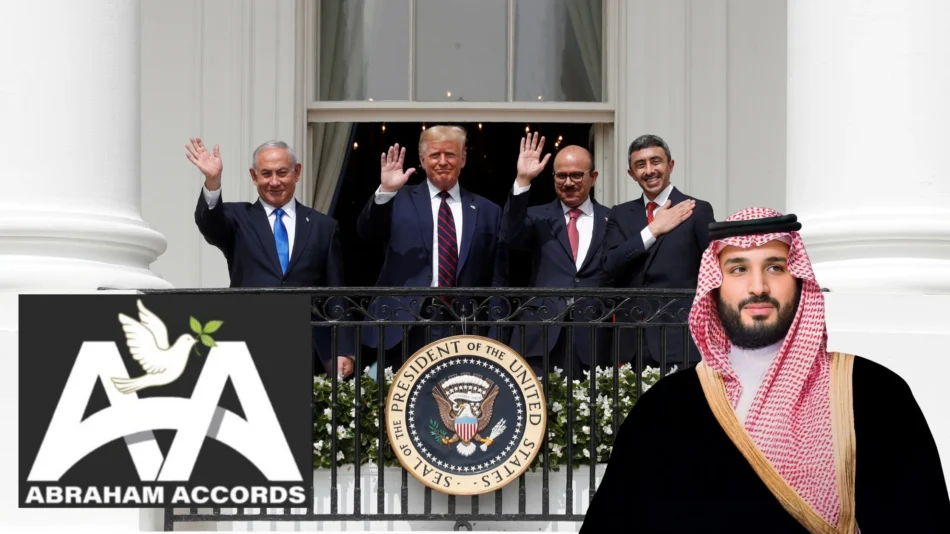

In a significant diplomatic development, Saudi Crown Prince Mohammed bin Salman has informed the United States that he cannot move forward with normalizing ties with Israel at this time. According to a report from Axios, this refusal is a direct setback to the U.S.-backed Abraham Accords and has left former President Donald Trump “disappointed and angry.”
The Crown Prince reportedly stated that the decision is due to strong domestic opposition within Saudi Arabia. Normalizing relations with Israel remains a highly sensitive issue in the Arab and Muslim world, and the Saudi leadership appears to be prioritizing internal stability and public sentiment over a swift diplomatic agreement.
PRIME MINISTER SHEHBAZ SHARIF PERFORMS UMRAH DURING SAUDI ARABIA VISIT
A Major Setback for Regional Normalization
The Abraham Accords, brokered by the Trump administration in 2020, saw the United Arab Emirates, Bahrain, Sudan, and Morocco establish formal ties with Israel. Saudi Arabia’s participation was long seen as the ultimate prize that could fundamentally reshape the Middle East’s political landscape.
This refusal highlights the enduring complexities of the Israeli-Palestinian conflict. For any broader Arab-Israeli reconciliation to succeed, it is widely believed that a credible path to a Palestinian state must be part of the equation, a point that Saudi leaders have consistently emphasized.
The decision underscores that despite shared concerns over Iran, a full normalization deal between Saudi Arabia and Israel remains contingent on resolving long-standing regional disputes.
Frequently Asked Questions (FAQs)
1. What are the Abraham Accords?
The Abraham Accords are a series of agreements normalized diplomatic relations between Israel and several Arab nations, including the UAE and Bahrain, facilitated by the United States in 2020.
2. Why did Saudi Arabia refuse to join?
According to reports, Crown Prince Mohammed bin Salman cited strong domestic opposition within Saudi society as the primary reason, indicating that public opinion is not yet in favor of such a move.
3. What does this mean for the Middle East?
This is a major diplomatic setback for U.S. and Israeli efforts to rapidly expand the Accords. It signals that Saudi-Israeli normalization is a more complex and distant goal than previously hoped, and it reaffirms the central role of the Palestinian issue in Arab diplomacy.
4. Is the door closed forever?
Not necessarily. The refusal indicates that the timing is not right, not that the possibility is permanently off the table. Future negotiations would likely need to address Saudi conditions, which include significant progress for the Palestinians.